Execution Guide
The Science of Execution.
A Research-Backed Framework for Turning Goals Into Results
By Elevist Product Team
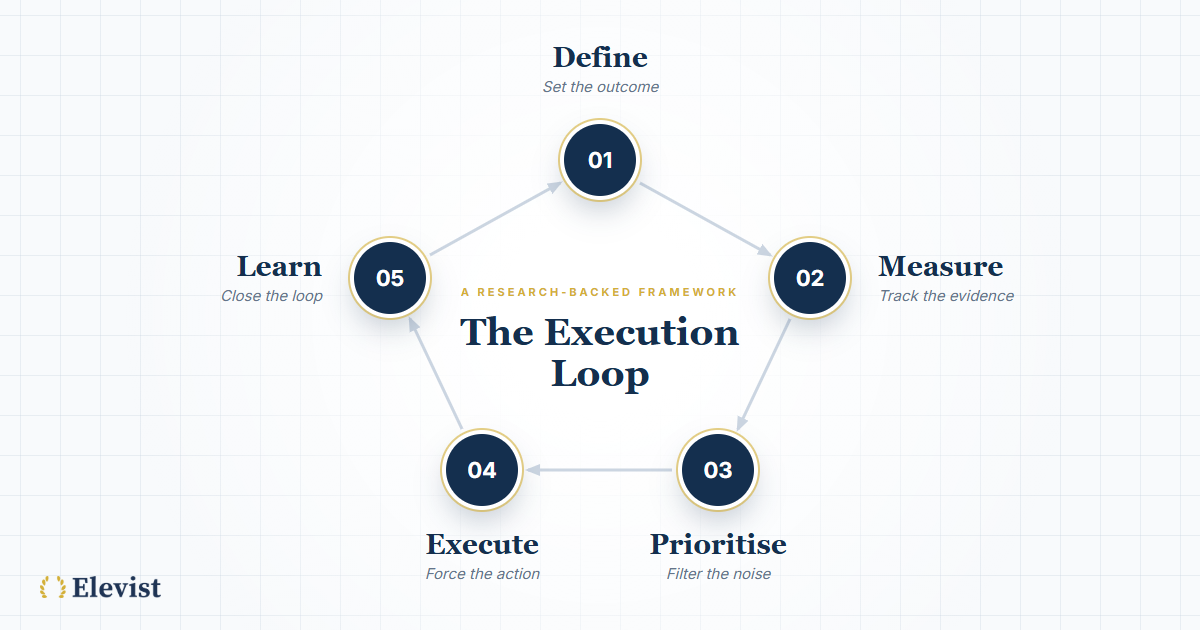
Most ambitious people have clear goals, yet turning those goals into daily progress remains a universal challenge. We have synthesized decades of behavioral research and operations management into a cohesive methodology designed to help anyone achieve their goals as fast as possible. When plans repeatedly degrade over a week, a weak execution process is usually the culprit. Reliable execution operates as a continuous feedback loop we call Elevist's Execution Loop: Define, Measure, Prioritize, Execute, and Learn. This guide breaks down the science behind each stage, providing a universal framework you can use to systematically optimize your output.
Each stage solves a different failure mode.
01 Define
"I am working hard, but I am not sure what success looks like."
02 Measure
"I cannot tell whether I am actually progressing."
03 Prioritize
"Everything feels important."
04 Execute
"I know what to do, but I do not consistently do it."
05 Learn
"I keep repeating the same patterns."
01 Define: Give your goal a measurable outcome
Execution without a defined goal is merely activity. The process must begin by establishing what winning actually means. Vague goals fail because they lack a clear definition of success. In a classic review of goal setting research, Locke and colleagues reported that specific and challenging goals produced higher performance than easy goals, no goals, or "do your best" instructions in roughly 90% of the studies they reviewed.
A specific goal still allows for operational flexibility. Goals must be challenging enough to matter, but clear enough that success can be objectively recognized and measured. A robust execution system translates high level goals into structured, measurable tasks. Clarity provides effort with a precise direction.
•
The Principle: Pair every goal with a specific outcome and timeframe so success can be objectively recognized and measured.
•
What you get: You replace a vague idea with a concrete goal, providing a baseline for operational control.
02 Measure: Make progress visible
A goal requires a mechanism to track movement. The overarching goal should be translated into measurable metrics, ideally including leading metrics that can be influenced directly. If the goal is a specific revenue milestone, the leading metric might be generating twenty qualified opportunities per week. Selecting this metric is a strategic choice, deciding that outbound volume matters more right now than deal size or response rate.
A large meta-analysis provides strong experimental support for the value of progress monitoring. Harkin and colleagues reviewed 138 studies involving 19,951 participants and found that interventions designed to increase progress monitoring improved goal attainment (d = 0.40). They also found a substantial effect on the frequency of monitoring itself (d = 1.98). Tracking progress creates a persistent record of reality. Tasks are activity; metrics are evidence.
•
The Principle: Translate overarching goals into measurable leading metrics, tracking them consistently to build a record of reality.
•
What you get: You stop relying on memory or gut feeling and gain objective evidence of whether the current strategy is working.
03 Prioritize: Decide what deserves attention now
Once everything is a priority, attention becomes fragmented. Research on attention residue provides one explanation for why this happens. When people switch away from unfinished work, part of their attention can remain attached to the previous task, impairing performance on the next one. Prioritization, therefore, goes beyond deciding what is important to identifying what deserves your attention right now.
Sorting tasks into
,000, 00, and 0 per hour tiers is a practical operational heuristic to highlight Strategic Drivers over low-leverage tasks. A reliable execution system evaluates which tasks are most likely to materially advance active goals and metrics, protecting attention for the tasks most likely to create meaningful progress.•
The Principle: Filter daily work by its expected impact on leading metrics and isolate Strategic Drivers from administrative noise.
•
What you get: You reduce the cognitive friction of constant task switching and reclaim peak hours for the tasks that drive progress.
04 Execute: Turn your priorities into tasks
Most productivity tools abandon the operator at the priority stage, providing a list and expecting discipline. A priority only matters once it becomes a specific task. Psychologists call this creating an implementation intention, following a simple logic: if a specific situation occurs, a specific task will be performed.
A 2024 meta-analysis by Sheeran, Listrom, and Gollwitzer examined 642 independent tests and found positive effects of implementation intentions across cognitive, affective, and behavioral outcomes, with effect sizes ranging from d = 0.27 to 0.66. The effects were larger when plans used a contingent if/then format, when participants were highly motivated, and when plans were rehearsed. Specifying the cue and response makes the intended task more concrete and easier to initiate when the relevant situation arises.
•
The Principle: Convert important priorities into concrete tasks with a clear cue, time, place, or situation for execution.
•
What you get: You reduce the number of decisions required at the moment of action and rely less on motivation alone.
05 Learn: Use reality to improve the next plan
Execution generates information, and reflection turns that information into better decisions. Operators must ask what worked, what failed, where projects repeatedly stalled, and what needs to change in the upcoming cycle.
Reflection can be a measurable performance intervention. In a field study by Harvard Business School, employees who spent the final 15 minutes of their day reflecting on what they had learned performed 22.8% better on a final training test than the control group. The control group spent those same 15 minutes continuing to work. Stopping to learn from the work frequently proves more productive than simply putting in more hours. The most effective way to mechanize this is through structured weekly reviews that audit planned targets against actual completed work.
•
The Principle: Conduct a structured weekly review to test assumptions, comparing the initial plan against what reality taught you.
•
What you get: You continuously learn what accelerates progress, allowing you to drop failing strategies and adapt the plan for the next cycle.
Closing the Loop
The loop runs continuously, but different parts operate at different speeds.
Longer Horizon
Define the goal
Regularly
Measure progress
Weekly
Learn and recalibrate
Daily
Prioritize and execute
Continuously
Capture evidence
Research behind Elevist's Execution Loop
The framework is grounded in peer reviewed behavioral science and operations research. Here is a summary of the underlying mechanisms.
This methodology is completely general. You can apply it using a paper notebook, spreadsheets, or a combination of standard productivity apps. However, most standalone tools only optimize one part of the execution problem. A task manager manages tasks. A calendar manages time. A documentation system manages information.
Maintaining the context connecting all five stages manually often becomes a full time job in itself. Elevist was built specifically to run this exact methodology. It unifies long term goals, measurable metrics, daily tasks, habits, notes, and weekly reviews into a single workspace so that each part of the system can inform the next.
The deeper value is preserving the context between every iteration of the loop. A human operator might struggle to simultaneously keep track of why a goal was chosen, which metrics are associated with it, which tasks have already been attempted, and what was learned in the last review. The Elevist Context Graph is designed precisely around that problem.
Rather than simply generating another task list, the true value of AI lies in using the accumulated context of goals, metrics, tasks, habits, and weekly reviews to continuously guide your execution and reason about what should happen next. Watch the Elevist product tour below to see exactly how this works in practice.
Ultimately, building a reliable system that learns from reality is far more valuable than trying to create a perfect initial plan.